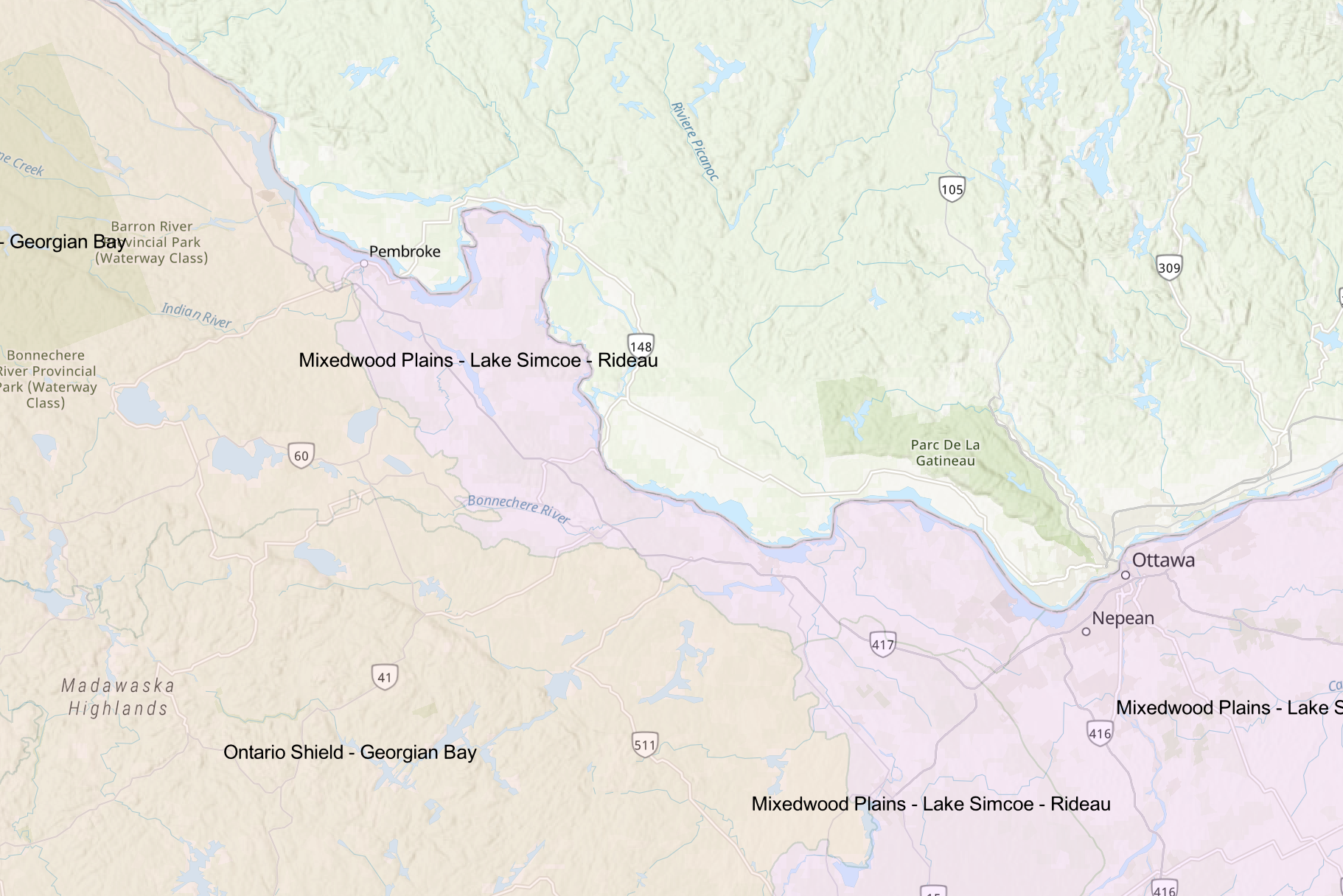
I’ve noticed that many plants labelled as native to Ontario, are native to South West Ontario, an area called the Carolinian Zone. There are plenty of organizations advocating for native plants in the Carolinian Zone because of the dense population and industry in that corridor.
The Ottawa Valley is quite different from the Carolinian Zone. A plant native to Windsor, Ontario, for example, might not contribute to the ecosystem here in the same way it does in Widsor.
Ecozones and Ecoregions
The Ottawa Valley is at the intersection of two ecological regions in Ontario. These regions are huge!
Ecozones and ecoregions are a system for classifying land that Ontario uses to delineate distinct ecosystems.
An ecozone is a large region with distinct bedrock from the areas adjacent to it. The interplay between the bedrock and weather patterns produce a unique ecosystem. Ecozones change very slowly in response to global or continental cycles. You can think of ecozones naturally changing over hundreds of thousands or millions of years.
Ecoregions are smaller, unique formations within a zone that can change quickly in response to the local climate. Ecoregions are susceptible to climate change and human activity, but are still thousands of hectares in size.
Ottawa Valley’s Ecozone
In Ontario, the Ottawa Valley has two ecozones, the Ontario Shield and the Mixedwood Plains. These are large areas that account for most of the province.
The Ontario Shield accounts for parts of the Ottawa Valley near the city of Ottawa, and includes the Ottawa River north of Renfrew.
The border between the Ontario Shield and Mixedwood Plains cuts a line through areas that are culturally referred to as the Ottawa Valley. In many of those places if you look east you’ll see lowlands leading to the river and if you look west you’ll see rock outcroppings indicating the beginning of the shield.
Ottawa Valley’s Ecoregions
Ontario Shield – Georgian Bay
The Georgian Bay ecoregion is the southern part of the shield known as the Precambrian Shield. If you live in Lanark County, you likely live in the Georgian Bay ecoregion and are surrounded by mixed forests, exposed rocks, and occasional flat, clay plains. The south-estern parts of Lanark County are In the Lake Simcoe-Rideau Region.
Forest species in this region include:
- Eastern White Pine
- Red Pine
- Easter Hemlock
- Yellow Birch
Hemlock has replaced Red Spruce in this region because Red Spruce has been largely eliminated due to poor forest management.
On dry sites you will find:
- Sugar Maple
- American Beech
- Wild Black Cherry
- American Basswod
- White Ash
Some boreal species grow in this region in cooler locations like:
- Black Spruce
- White Spruce
- Balsam Fir
- Jack Pine
- Tamarack
And, finally, you will find Balsam Fir growing in the understories here.
The landscape here provides rich habitat for animals including the Little Brown Bat, Black Bear, Moose, Fisher and many others. Warblers abound here along with a few newts, salamanders, frogs, turtles, and snakes.
Mixedwood Plains – Lake Simcoe-Rideau
The Lake Simcoe-Rideau ecoregion includes Manitoulin Island and extends from Lake Huron to the southern part of the Ottawa River. The bedrock is deep in this ecoregion as receding glaciers deposited lots of soil here. This ecoregion is home to a special ecosystem called an alvar, a limestone bedrock with shallow soil deposits. Alvars flood in the rain and dry out in the summer, making a unique ecosystem for shrubs and low vegetation.
The forests in this ecoregion are dominated by deciduous trees icluding:
- Sugar Maple
- American Beech
- White Ahs
- Easter Hamlock
- Green Ahs
- Silver Maple
- Easter White Cedar
- Yellow Birch
- Balsam Fir
- Black Ash
The northern edge of this region is home to peatlands, fens and a few bogs that host Black Spruce and Tamarack.
Lake Simco-Rideau is home to White-tailed Deer, Racoons, Skunks, woodchucks, plenty of shore birds including Wood Ducks and Great Blue Heron. The Northern Leopard Frog, Spring Peeper, and American Bullfrog occupy the vernal ponds and wetlands.
References:
- The Ecosystems of Ontario, Part 1: Ecozones and Ecoregions
- Feature image taken from Ecological Zones and Ecodistrics of Ontario