We have a garden full of Asters. Last week, I started to wonder how long that would last because I noticed some of our Purple Coneflowers were blooming funny and had odd, spiky shapes coming out of them caused by an infection called Aster Yellows.
Aster Yellows is relatively rare in Ontario but can get bad in years with strong southerly wind in the spring followed by a cool, rainy summer. Aster Yellows is caused by a bacterial infection and affects more than 300 species, most of which are in the Asteraceae family including Purple Coneflower, Coreopsis, Marigolds, and Sunflowers, as well as vegetable and grain crops.
There is no cure for Aster Yellows and depending on the strain that has infected the plant and the climate conditions, the symptoms can range from deformed, poorly growing plants, to something you don’t notice at all.
There are lots of detailed articles about Aster Yellows, so I’m not going to repeat that information here (but I’ll add a few links I found helpful below).
How Aster Yellows is Transmitted
The Aster Leafhopper (Macrosteles quadrilineatus), an insect Native to North America that travels on the wind, transmits the disease from one plant to another. Only 5% of Leafhoppers carry the infection but leafhoppers are fairly prolific.
The leafhopper feeds on an infected plant causing a bacterial infection in the leafhopper’s digestive tract. The infection does not affect the leafhopper. The leafhopper then does it’s leaf hopping thing and hops to a new plant. When it feeds on the next plant, the bacteria infects the new plant and begins to multiply.
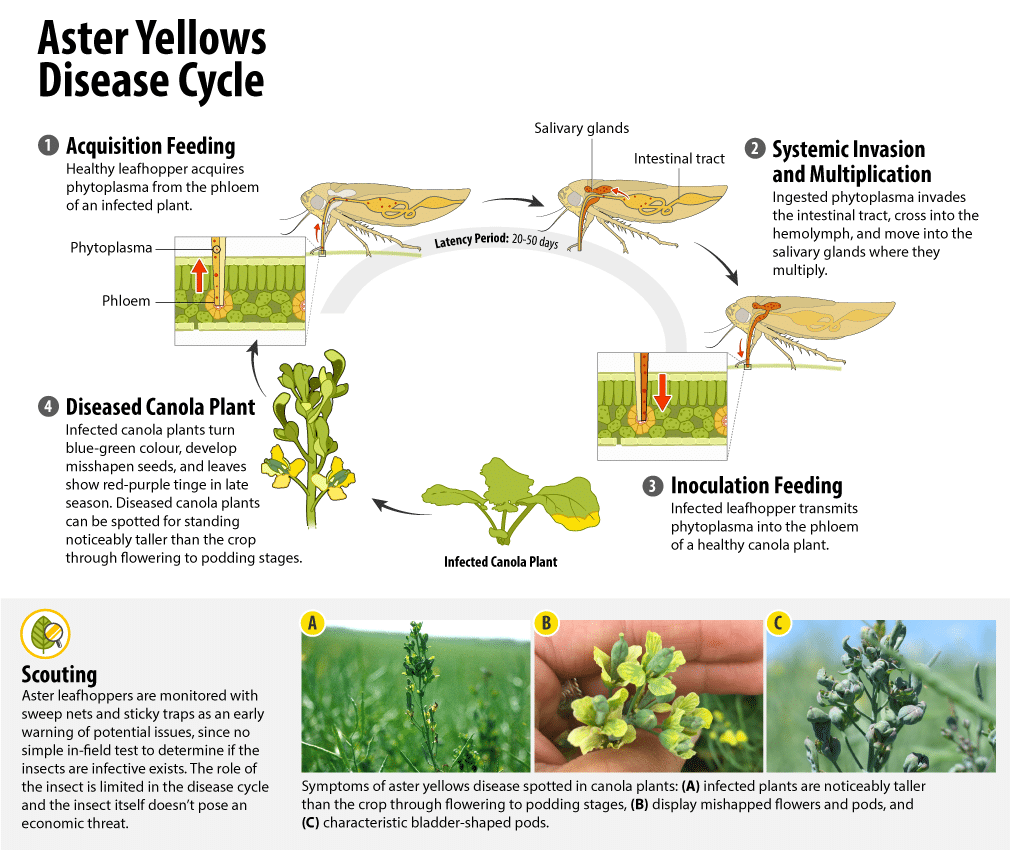
Canola Council of Canada aster yellows disease cycle graphic
Why do Some Plants with Aster Yellows Look Worse than Others?
Aster Yellows takes 10 to 40 days to become visible in a plant and symptoms will be more acute in a plant that is actively growing because its leaves and flowers will become distorted.
It is possible for a plant to get infected late in the season and then not display symptoms until the next year.
Similarly, some plants will be asymptomatic either due to the plant’s growing conditions or it simply won’t show visible signs of infection.
How We Manage Aster Yellows
The key piece of information that helped me understand Aster Yellows was that some plants can be asymptomatic. Meaning you might have a Cone Flower that is in rough shape showing symptoms and a Golden Rod showing no symptoms. But they both could have it.
We do our best to remove Aster Yellows to protect our veggie beds and our native plants, but we know that there is no way of keep it out of our yard.
Destroy Visibly Infected Plants
This is the sad part. I hate killing a plant but I also hate having a diseased plant that could impact our veggie beds. On the first year of infection, a plant with Aster Yellows might not show many symptoms, but on the second year, when the bacteria has time to spread in the plant, the symptoms will be severe.
When we see signs of Aster Yellows, we bag up the plant and throw it in the garbage. It doesn’t go in our compost pile because the plant will stay alive there for a bit longer and leaf hoppers could still spread the disease.
We still destroy plants that have minor signs of infection because they will come back worse next year.
Let Other Plants Be
There really is no guaranteed way of knowing if a plant has Aster Yellows if it isn’t showing obvious symptoms (distorted flowers, petals growing out of the wrong spot, etc.), but if it’s not showing symptoms, we let it be.
Use Light Coloured Mulch
Light coloured mulch has been shown to confuse leaf hoppers because they rely on the colour navigate. We are mulching with wood mulch and straw.
Remove Dandelions, Plantain, and Other Weeds
It never hurts to remove unwanted weeds from your gardens and pathways. Pulling dandelions and plantains helps reduce the chance of a leafhopper feeding on an infected plant.
Resources
- Canola Council of Canada: Aster Yellows
- Wikipedia: Aster Yellows
- ontario.ca: Aster yellows in vegetable crops
- Colorado State University: Aster leafhopper and aster yellows
- The Spruce: Aster Yellows: Symptoms, Treatment, and Prevention
- Almanac: Aster Yellows Plant Disease: How to Identify and Prevent It