Author: wildpatch

  • Should I Add Mushroom Compost to my Veggie Bed?

    Like any good question: it depends! Mushroom compost can clump, has lots of organic matter, has a high pH, and is high in some minerals. Each plant will respond differently to mushroom compost.

    Here’s a helpful breakdown that I found on a poster at a local community garden. Thanks community garden organizers!

    This table comments on the nutrient, acidity, and pH contents of compost. Given that every compost source is different, its a good idea to test your soil and compost so you know what you’re changing by adding compost.

    VeggieMushroom Compost?Notes
    Tomatos✅ YesBenefits from the nutrients and moisture retention.
    Peppers✅ YesThrives with improved drainage and nutrients from compost.
    Cucumbers✅ YesBenefits from the nutrients and moisture retention.
    Squash (Zucchini, Pumpkin)✅ YesBenefits from the nutrients and moisture retention.
    Corn✅ YesHeavy feeder – mushroom compost provides a good nutrient boost.
    Lettuce, Leafy Greens⚠️ CautionSmall amounts help, but too much can make soil too rich or alkaline.
    Spinach🚫 NoPrefers neutral to slightly acidic soil; mushroom compost is often too alkaline.
    Carrots🚫 NoCompost can cause forked roots; best in looser, sandier soil.
    Beets⚠️ CautionCan tolerate a little, but does not like high acidity. Excess nitrogen, promotes leaves, not roots.
    Radishes⚠️ CautionUse in moderation to avoid excess nitrogen, which promotes leaves, not roots.
    Potatoes🚫 NoHigh lime content in mushroom compost increases risk of scab.
    Onions & Garlic⚠️ CautionTolerate small amounts but prefer leaner, well-drained soil.
    Beans & Peas⚠️ CautionCan grow in it, but prefer less rich, neutral soil.
    Brassicas (Kale, Broccoli, Cabbage)✅ YesThrives in the high nitrogen environment from the compost.

    Nutrients Profile of Mushroom Compost

    Mushroom compost contents can vary depending on where you get it and what types of agriculture are near by. Typically, compost is made using three types of ingredients: a source of carbon like straw, corn cobs, or poultry litter, and a source of nitrogen like manure.

    The compost is mounded up and soaked with water so it begins decomposing. Then it’s heated up to inoculate it and prepare it for mushrooms. Once the grower has used the compost for mushrooms, the spent compost is sold at your local garden centre or given away if you’re lucky.

    According to the American Mushroom Institute mushroom compost on average is comprised of:

    • 2.29% calcium
    • 1.24% potash (potassium),
    • 1.12% nitrogen
    • 1.07% iron
    • 0.67% phosphate (phosphorous)
    • 0.35% magnesium

    Most plants prefer a slightly acidic soil with a pH between 6.0 and 7.0. A pH of 7 is neutral. On average, mushroom compost has a pH of 6.6.

    The carbon to nitrogen ratio of soil is important because it indicates the balance between energy sources for beneficial microbes (carbon) and nutrients used to build proteins (nitrogen).

    High carbon content will result in higher microbial activity that competes for nitrogen with the plants because the microbes need the nitrogen to consume the carbon-based plant material in the soil.

    Soil for growing food should have a carbon to nitrogen ratio of around 24:1. Mushroom compost has 13:1 ratio which means it is high in nitrogen and has a reasonably good content.


    Sources
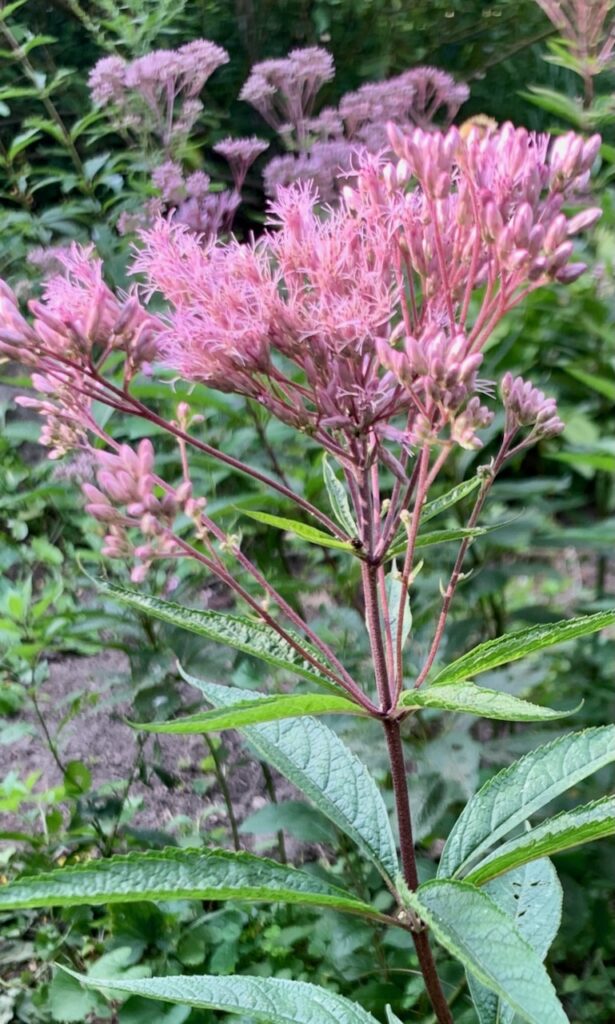
  • Spotted Joe Pye

    Spotted Joe Pye

    Binomial: Eutrochium maculatum

    Joe Pye is a versatile, easy-to-grow plant that thrives in moist, well-drained soil. It’s capable of handling many conditions but struggles in very dry conditions.

    This plant provides beautiful texture and structure to our garden, and provides showy, light pink flowers that attract pollinators of all kinds.

    We have a couple of patches of Joe Pye in our yard. They grow between three and five feet in height, but one patch gets up to 12 feet!

    We use this plant to create height towards the back of our garden beds and to create a quick-growing privacy screen in front of our kitchen window.

    We have both the straight native and a nursery cultivar in our yard. The nursery cultivar is much denser and taller than the straight natives, but it does not spread by seed on its own.

    The straight natives spread by seed in moist conditions, but are not aggressive. Since we have two variations, I wouldn’t consider our seedlings to be straight natives. There is a very good chance they are cross-pollinated with the nursery cultivar.

    Why We Chose Spotted Joe Pye

    Spotted Joe Pye is a true native of Eastern Ontario. You can find it in damp meadows and along waterways. We’ve seen Joe Pye and its close relative, Boneset, on many canoe trips in Ontario and Quebec.

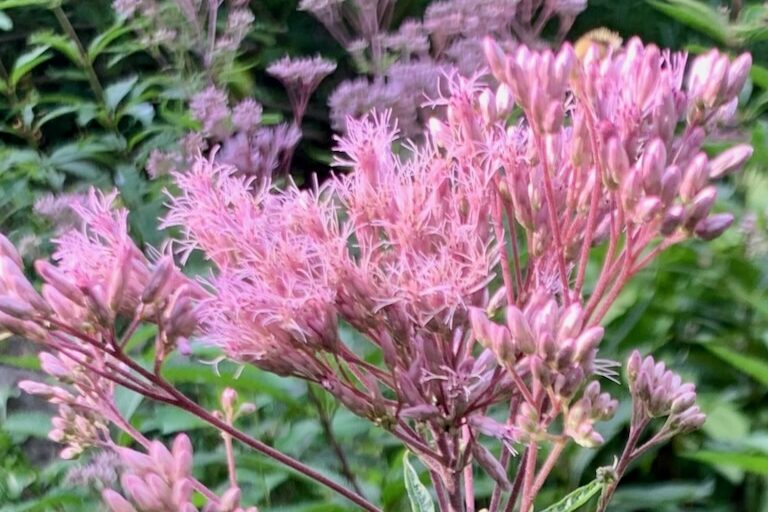
    We love the height and texture this plant adds to our garden. Its staggered leaves and cloud-like flower clusters give the garden beds a natural texture. Plus, pollinators love this plant. As soon as it blooms, its buds are busy with flying insects and butterflies.

    A plant with narrow pointed leaves up the stem and fluffy, pink flower clusters at the top.
  • Meadowsweet

    Binomial: Spirea alba

    We found our first Meadowsweet at a local nursery. We were surprised to find a straight native at a conventional nursery, but meadowsweet is such a showy plant on its own that the nursery must have realized it sells itself!

    Meadowsweet is a versatile plant in moist to wet soils. We have ours planted downhill from our drain pipes. The soil in this area is relatively dense clay with a layer of sandy loam on top. The area gets all-day sun until about 3 pm and can dry out during low-rain periods.

    Many guides say Meadowsweet needs wet soil, but that hasn’t been the case for ours. We might be pushing the extreme of its dry tolerance. There was a drought last summer, and it survived with no extra watering, but it grew significantly less than in the years before.

    We have a second Meadowsweet in a rain garden next to a high-volume downspout. This particular plant hasn’t had a good time. It has occupied three different locations in our yard, each with its own challenges. First getting crowded out when it was young (our fault!), then drying out on a berm we thought had more moisture than it did. The downspout location is new this year and should be a great resting spot for this plant.

    Popular with Polinators!

    Meadowsweet is a busy plant when it’s in full bloom! Bees, wasps, and flies love the delicate aromatic flowers, and so do we! It’s a very showy plant.

    Why We Chose Meadowsweet

    Its delicate white flowers are a wonderful replacement for Bridal Wreath Spirea, a non-native sibling. When we moved in, we had two Bridal Wreath Spiraeas, and their drooping branches looked too opulent for our style. Meadowsweet’s mound shape and conical flowers provide a strong anchor point in our garden and attract far more pollinators than the Bridal Wreath they replaced.

    We also chose Meadowsweet for water management. We have drainage that comes down one side of the house. During the melt, we get a small spring trickling out of the grass onto the sidewalk. We’ve planted moisture-loving plants along this strip to absorb and retain more of this water before it hits the street.

    Meadowsweet is a larval host for the Spring Azure butterfly, a stunning little blue butterfly that you see in the early spring.

  • Welcome to Wild Patch

    Welcome to Wild Patch

    In 2023, we moved to the Ottawa Valley and started a native plant garden on our 1/2 acre in town. We have learned a lot, and this blog will document some of the things we’ve learned.

    We are also working on a native plant database unique to the Ottawa Valley and Lanark County. Over the years, we’ve collected information from a whole bunch of resources to piece together what works in our yard and how to grow plants that are truly native to this region.

    We have many plants thriving in our yard that bugs and birds love, and we’ve learned that some of them don’t have a native range this far north. Many resources list native plants by province or growing zone. Ontario is HUGE! A plant native to south-west Ontario might never be seen in the Ottawa Valley.

    We want to grow plants that support the local ecosystem of bees, bugs, birds, and other wildlife. So we’re doing our best to learn how to grow a garden that supports the changing ecosystem we live in.